
HOLY METROPOLIS OF CHALKIS
ISTIAIA & THE NORTHERN SPORADES
ISTIAIA & THE NORTHERN SPORADES
HISTORY OF THE HOLY MONASTERY OF SAINT NICHOLAS GALATAKI OF LIMNI, EVIA
A. GENERAL INFORMATION ABOUT THE MONASTERY
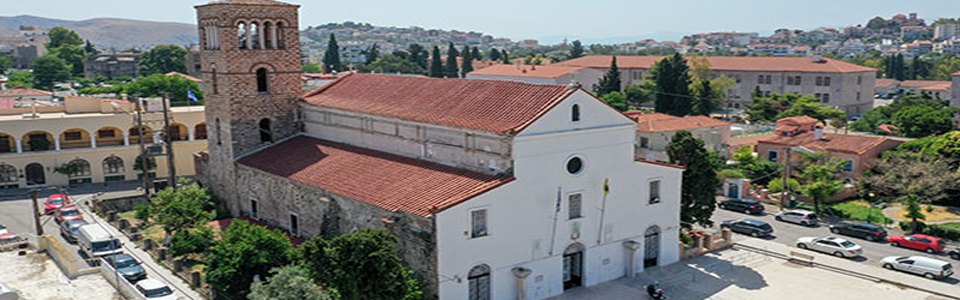
The topography of the area. The historic Monastery of Saint Nicholas, called Galataki, is located on the southwestern slopes of the steep Kandili Mountain in Northern Evia. Its sacred structure rises on a natural plateau of a few acres, situated 120 m above sea level and accessible only from the west.
The monastery is surrounded, in its immediate perimeter, by olive groves totaling 40 acres, while the wider perimeter is occupied by a forest under ownership, extending over the northern, northeastern, and northwestern slopes and ridges of Kandili. In the eastern olive grove of the monastery, 200 meters from its enclosure, there is the cave-like chapel of Saint Andrew, with fragments of frescoes, likely from the early 17th century. Northwest, a few meters from its enclosure, there is a modern chapel dedicated to Saint Nektarios, while to the west, 200 meters away, rises a steep rock called Korakolithos. According to recorded tradition, pirates ambushed and killed a monk/guard on this rock, formerly used as a lookout. Today, the rock is marked with a large white cross, placed in the 1970s through the efforts of the late Abbess Theoktisti.
West of the monastery, twelve kilometers away, lies the picturesque town of Limni, capital of the current Kapodistrian Municipality of Elymnion. North, just behind the Kandili mountain mass, is the settlement of Troupi, and northwest is Spathari. To the south, the wide Evian lagoon stretches, with a coastal fault starting from the eastern seashore of Kandili and ending at the western seashore of Telethrio Mountain, considered the deepest point in the Evian Gulf. Therefore, from Galataki Monastery, one has an obligatory view toward the southern and western horizons, as it is surrounded to the north and east by the Kandili mountain mass.
The pilgrim wishing to visit the historic monastery today has at their disposal a half-asphalted carriage road, which starts from the beach of Limni and passes through the picturesque locations: Katounia, Marantza, and Agios Georgios, ending at the monastery entrance. Other access roads, simple forest roads connecting to surrounding mountain settlements, are rarely used today due to poor condition and dangerous spots caused by cross-sections in the road, while the path to Troupi (3 hours on foot) is impassable during winter.
Abbess: Nun Mariam Panourgia (6 nuns)
Phone: 22270.31489.
Postal Address: 340 05 Limni.
HISTORICAL DATA
The founding tradition of the monastery and its history. The Monastery of Saint Nicholas Galataki has composed, from its very foundation, its own distinct path and grandeur, among the other monasteries of Euboea. However, clear information about the first or the initial founders of the monastery, or any exact date for its foundation, has not been provided by research so far.
Thus, the tradition remains widespread that the Galataki Monastery was founded by a Byzantine emperor at the end of the 7th or the beginning of the 8th century, and those who refer to its history do not fail to emphasize this fact, citing a sigillion of the Ecumenical Patriarch Cyril V (1752), which is preserved in the monastery's archive and in which it is referred to as a "Royal and Stavropegial Monastery".
The possibility that the origin of the Galataki Monastery is traced back to the Byzantine era through tradition is not unique in the monastic history of Greece, nor is it inexplicable. The tendency and romantic disposition of monks, especially during the 19th century, for reasons of prestige and authority, but also for more substantial reasons, such as the calculation of privileges and economic benefits, to attribute imperial and royal titles to their monasteries and to consider Byzantine emperors as their founders, is well known. For the record, the above founding tradition of the monastery is first found in a written source dated August 5, 1899.
More specifically, in a report by the abbot of the monastery Agapios Papaspyropoulos (1898-1904) to the Prefecture of Euboea, requesting approval of a fund of 890 drachmas for the renovation of the building and church complex, it is mentioned: "According to tradition, the monastery was built by a Byzantine Emperor 900 or 1000 years ago". According to the testimonies of documents from the Ottoman archive of the monastery, we can define the 16th century as its peak, as then a series of notable abbots proceeded with a comprehensive renovation of the building complex, worn out by time and raids.
Among the factors that influenced these new developments at the Galataki Monastery, we mention, in chronological order, the following:
a) The political and economic circumstances that developed in Northern Euboea during the reign of Sultan Suleiman I (1520-1566). The new political and economic conditions, products of the Pax Ottomanica that prevailed throughout the Ottoman Empire, allowed for the developmental management of the monastery's land property and the investment of the financial surplus in works necessary for the monastic brotherhood.
b) The securing of the monastery with stavropegial privileges. According to strong indications, the subordination of the monastery under the protection of the mother Church must have taken place during the third patriarchate (1537-1545) of the monastic-loving Ecumenical Patriarch Jeremiah I and aimed at freeing the monastery from the pressures of the local bishops of Kanalia and the archbishops of Evripos. The stavropegial rights of the monastery were subsequently renewed by the Ecumenical Patriarchs of the 17th and 18th centuries [Methodius III (1669), Cyril V (1752, 1753), Joannikios III (1761, 1762), Meletius II (probably 1768-9)].
c) The settlement of Saint David in Northern Euboea and the parallel foundation of the Monastery of the Transfiguration of the Savior (around 1550), in a place where the Galataki Monastery had previously dominated. This event acts as a sanction for the historic monastery and simultaneously defines new behavioral data for the monks throughout the 16th century.
The first written testimonies about the history of the monastery appear in a Sultan's decree issued in 1503 by Sultan Bayezid II. According to its content, the Galataki Monastery had started a program of construction works long before that year, with the main purpose of protecting it from pirate raids: "Since their Monastery is located near the sea," it is stated in the decree, "and pirate ships coming would plunder their belongings and harm them, to protect themselves from them, they built a wall and also placed an iron door, according to the old custom." Overall, the above testimony and especially the phrase "according to the old custom," acquire particular significance for an additional reason. Indirectly but decisively, they depict the earlier, pre-Ottoman conquest, external image of the monastery, which should not have differed much from the typical form of the monasteries of the Justinian period, with its distinctly fortress-like style.
The next testimonies for the execution of repair works on the monastery's building complex date back to 1562. Then the monks, with permission from the Kadı of Evripos, "Derviş Mehmet," renovated "some of the cells where the monks reside, being dilapidated from age and in need of repair, as their roof is decayed and lacks solidity. And the mentioned courtyard also needs repair." Alongside their personal, comfortable, and safe living, the monks also take care of the hospitality of pilgrims, for whom they build "a house for the hospitality of travelers coming in winter and summer." Unfortunately, from the content of the text, it does not emerge in which wing the monks built the above houses, so as to have the image of the then layout of its buildings.
In 1588, the Galataki Monastery is described as a "frightened Monastery," because the frigates of the Turkish fleet anchored in the bay below the Monastery plunder its belongings, as they easily invade its enclosure through an opening that exists "on the eastern side of the enclosure." With permission from the "Kadı Evripos Ali," the monks "built a new elongated residence on the East, containing some separate residences corresponding to Mihram. As a kind of shelter, from robbers and vagabonds, without it being a matter of any purchase or any situation contrary to the sacred law."
Additional testimonies for other renovations of the building complex during the years of Turkish rule are not available. However, it would be a mistake to exclude them, as the available sources mention destructions of the monastery by pirates, natural phenomena such as earthquakes, which were frequent in the area, and fires. In such a case of fire, in 1756, which destroyed the buildings of the southern wing of the monastery, a collection was attempted in Constantinople and other areas under the jurisdiction of the Ecumenical Patriarchate, with the holy relic "of the right hand of the holy glorious and all-praised Apostle Andrew the First-Called," to gather the necessary funds that would allow their reconstruction. However, a later document informs us that the construction of the southern wing did not take place immediately after the end of the collection, but much later, specifically in 1894, by the then abbot Leontios Korachai.
In 1787, a bloody incident, probably related to the issue of continuous Holy Communion, led to the temporary dissolution of the monastery, while its reorganization by the abbot Dionysios Chalkas, which took place around 1800, was short-lived, partly due to the predatory intentions of Turkish creditors of the monastery, and partly due to the events that followed the outbreak of the Greek Revolution.
Holy Metropolis of Chalkida
Head Office: Chalkida, Vaki 21, P.C. 34133
Email: imchalkidos@yahoo.gr
Telephone Center: 22210.60404
FAX: 22210. 61505
Metropolitan: H.E. Chrysostomos (17.12.2001)
Protosyncellus (ext. 8): Bishop of Skopelos H.E. Nikodimos
General Archieratical Commissioner:(ext. 7)
Accounting – Treasury:(ext. 5)
 Radio Station of the Holy Metropolis of Chalkida
 Facebook
 X / Twitter
 Instagram
 YouTube